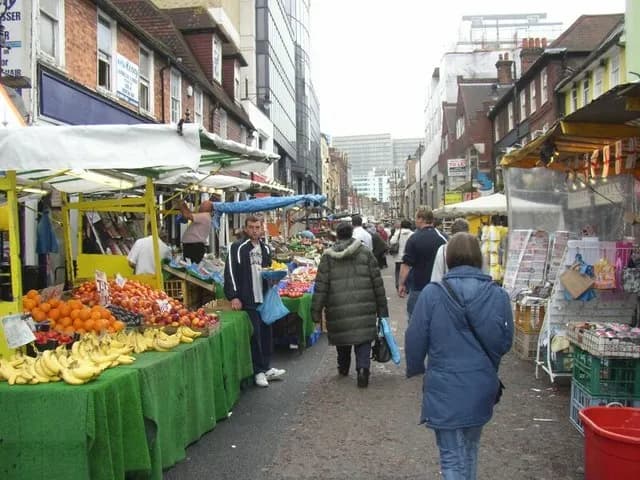
Surrey Street Market began in 1276 when Robert Kilwardby, Archbishop of Canterbury, granted a market charter to Croydon. Some records suggest trading may have taken place on the site as early as 1236, but the 1276 charter marks the first formal recognition of a market that would shape the town's development for centuries.
A Medieval Marketplace
The original marketplace occupied a triangular area bounded by what are now High Street, Surrey Street, and Crown Hill. The higher ground to the east was given over to corn trading, whilst the lower western side, then known as Butcher Row, handled livestock, meat, and hides. The division reflected the practical needs of a growing settlement that served both local farmers and travellers on the route between London and the south coast.
The 1276 charter authorised a weekly market on Wednesdays. Subsequent charters shifted the trading day, first to Thursdays in 1314 and then to Saturdays around 1343. Saturday remained the principal market day until the mid-nineteenth century, by which time Croydon had grown into a busy market town serving a wide agricultural hinterland.
From Open Market to Street Trading
By the later Middle Ages the open marketplace had begun to fill with permanent buildings. Croydon Corporation bought a market house for corn trading in 1566 and replaced it with a new building in 1609. The older structure was repurposed in 1708 as a general provisions market, known as the Butter Market, which continued until 1874.
The physical transformation of the market area accelerated in the nineteenth century. In 1893 Croydon Corporation cleared and redeveloped the Middle Row area, consolidating street trading along Surrey Street. The corn market moved to Thursdays in 1861 and ceased in 1907, whilst the general provisions market continued on Saturdays until 1874 before carrying on as an unofficial street market.
A Six-Day Market
The modern form of Surrey Street Market dates to 1922, when Croydon Corporation took over the street market and relaunched it as a six-day-a-week operation, running from Monday to Saturday. Saturday remains the busiest day for traders and shoppers alike. In 2024 the market comprised 68 stalls, the majority selling fruit and vegetables.
The market has adapted to Croydon's changing fortunes. It sits behind the Grants of Croydon entertainment complex and is regularly used as a location for television, film, and advertising shoots. Charles, Prince of Wales, visited the market in November 1994, drawing national attention to a trading tradition that had then spanned more than seven centuries.
A Constant in a Changing Town
Croydon has been reshaped repeatedly since 1276, from a small market settlement to a major commercial centre and the focal point of the London Borough of Croydon. The market has survived the redevelopment of the town centre, the decline of traditional market towns, and the growth of out-of-town retail. Its continued presence on Surrey Street provides a direct link to the charter that first put Croydon on the map as a place of trade.